The Face and the Mother
A synoptic icon: the Mandylion at the centre, the Mother of God at the four arms
This project was first imagined after my first encounter, in the icons room of the Diocesan Museum in Bari, with a synoptic icon of four Madonnas arranged around the crucified Christ. The historical images and titles used here are inherited; their cross-shaped placement and the movements Reception, Embrace, Direction and Abiding are my own interpretative construction.



How to look
You do not need theology to begin here. Begin with looking. At the centre is a face on a cloth; around it are four images of the same mother and the same child, painted centuries apart in Novgorod, Kastoria and Crete. Linger wherever you find yourself lingering. An icon is not a picture that delivers information but a place where a meeting can happen: the old teachers said that the honour paid to an image passes to the one it shows. The notes below record what a longer look tends to discover. The art itself is the door; everything written here is only a hinge.
The face not made by hands
The centre is the only image in the composition without Mary, and, tradition says, the only one never painted at all: a face left upon a cloth, called in Greek the acheiropoieton, “not made by hands”. Scripture speaks this way too. Daniel dreams of a stone cut out of the mountain without hands, which breaks the kingdoms of the world (Daniel 2:34, 45), and Paul writes that God has shone in our hearts to give the light of his glory in the face of Jesus Christ (2 Corinthians 4:6). Yet this face belonged to a body, and the body came from a woman (Galatians 4:4). That is what the four arms show: through his mother he is conceived (above), shown to the world (at his left), embraced (at his right), and buried (below). Her consent, be it unto me according to thy word (Luke 1:38), is the door by which the unmade image entered the world of made things. In this composition, Mary is the hand of the handless image.
Right and left
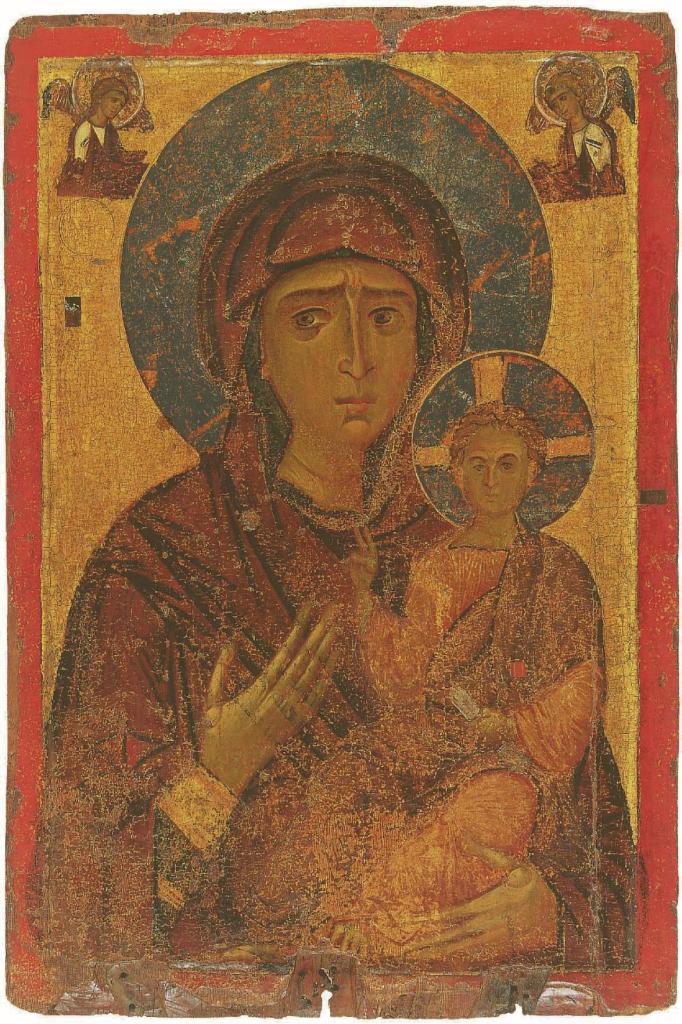
Sides are counted from the face at the centre, not from where you stand. So the tender image, the Kardiotissa, Our Lady of the Heart, hangs at his right hand, the side of honour: sit thou at my right hand (Psalm 110:1); his right hand doth embrace me (Song of Songs 2:6). The pointing image, the Hodegetria, She Who Shows the Way, stands at his left, directing every eye across the composition to him, as she directed the servants at Cana: whatsoever he saith unto you, do it (John 2:5). Love holds the place of honour, and teaching serves it. This arrangement is chosen, not accidental.
The missing resurrection
Follow the vertical line downward: conception, the face, the tomb. It stops there. There is no resurrection panel, and the omission is deliberate. The largest roundel, with the heaviest frame and a doubled beam reaching it, is the lowest one: the dead Christ with his mother, on the day between Good Friday and Easter. And Mary sat over against the sepulchre (Matthew 27:61); the women rested the sabbath day according to the commandment (Luke 23:56). The icon ends where the waiting is, because that is where we are. What visibly survives the tomb is the face itself, which does not die because it was never made. Though it tarry, wait for it (Habakkuk 2:3).
The five movements
The Face at the centre. Reception above: be it unto me according to thy word (Luke 1:38). Direction at his left: I am the way (John 14:6). Embrace at his right: set me as a seal upon thine heart (Song of Songs 8:6). Abiding below: now there stood by the cross of Jesus his mother (John 19:25). She receives him, reveals him, loves him, and remains with him. If you keep only one sentence from this page, keep that one.
The doors
An icon with doors shows two times. Open, you see history still underway: the mother and the child, the road, the tomb, the waiting. Closed, you see how the story ends. The exterior is a page in the manner of the great Spanish Beatus manuscripts, a thousand years old: the Lamb standing on Mount Sion, and with him the multitude with harps, singing as it were a new song, a song no one else could learn (Revelation 14:1 to 3); above them, the elders and the winged creatures about the throne (Revelation 4 and 5). It is not a battle scene. The end of the story is pictured as music.
The child carried in the topmost roundel inside and the Lamb on the mountain outside are the same person, at the two ends of time. Close the doors, and the music faces the world while the face withdraws behind it. Open them, and the waiting resumes. The resting state of this icon is open, because the hour is not yet: closing the doors is rehearsal, not yet performance.
Sources and construction. The historical images are identified below; the synoptic form, spatial relations and four Marian movements are original to this work. Interior, centre: the Mandylion of Novgorod, twelfth century, Tretyakov Gallery. North: the Znamenie, St Sophia, Novgorod. West: Akotantos, Virgin Kardiotissa, Byzantine and Christian Museum, Athens. South: Tzafouris, Pieta, Cretan school. East: the Hodegetria of Kastoria, Byzantine Museum, Kastoria. Exterior: the Adoration of the Lamb on Mount Sion from the Valcavado Beatus, 970. The icon is at home in an ordinary browser.