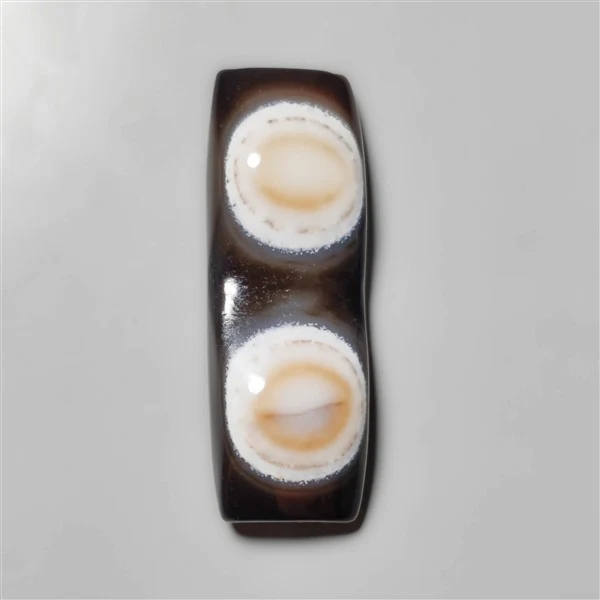
In the photograph the stone is an elongated dark-brown rectangle, nearly three times as long as it is wide. Its corners are rounded and its sides bow slightly. Two pale oval areas lie along its length, each bordered by an uneven white ring. Their centres are cream and honey-coloured; a darker oblique band crosses the lower one. Small white reflections sit on the polished surface. The forms are similar, but not identical.1
I have held back the word eyes. Once admitted, it gathers those differences into something familiar. Upright, the circles remain one above the other, each separately eye-like. A quarter-turn places them side by side, making a paired gaze easier to see. No mineral structure changes. What changes is how the two forms belong together for someone looking, and a setting would favour one arrangement. The position of the bail is already an interpretation.
The two pale centres hold my look. Their clouded interiors give me no expression to read, yet the dark shape now faces me. I have become conspicuous before it. The longer I look, the less the photograph offers a thing awaiting inspection: there is something keeping watch while I consider how close to bring it. I am imagining wearing what already has me in view.
There is a small confession behind this. I had seen the stone and moved on, then dreamt it as a pendant, doodled it and returned to buy it. The research followed that sequence. Wanting had already entered the looking, and reading might help me understand what happened or merely dignify a purchase already made.
The difficulty is not that desire helped something become visible. It is that I might borrow the stone’s apparent authority to justify what I wanted. Recognising a figure gives me a possibility to work with; what I make of it remains my decision. Attentive making begins by acknowledging that responsibility rather than presenting my choice as obedience to the material.
Roger Caillois both exposes and entertains the temptation. In The Writing of Stones, human art belongs within an abundance of forms which it neither originates nor exhausts. Yet he describes a figured limestone as containing “signs which have no meaning”, swiftly given meaning by imagination. He knows, too, that a portrait in stone requires a fortunate cut and a collaborating beholder. Pictures do not simply wait complete inside his rocks.2
The greater temptation comes when he moves towards a universal syntax, almost “a call from the center of things”.3 Here the title’s writing without a human writer suggests more than patterns available for comparison. Stone and imagination seem to recognise one another across an immense distance. That possibility gives the book its force, and I would not answer it by declaring stone meaningless until a person supplies significance. But continuity of form does not establish the authority of a particular reading. Even granted Caillois’s universal syntax, it would not tell me whether these circles should become a pendant, much less whether they should watch over its wearer.
My first description was no recovery of innocent sensation. White already stood against brown; a border already gathered a centre. Merleau-Ponty takes figure and background as basic to perception, rather than something assembled afterwards from isolated impressions.4 Withholding eyes suspends one recognition, not every organisation of the visible. It lets me notice the oblique band, the uneven borders and the differences between the centres which the likeness had encouraged me to pass over.
Peter Philippson approaches bracketing through the habits and expectations the perceiver brings. Its purpose is to make that participation more available to examination.5 I borrow this as a descriptive discipline rather than treating Gestalt field theory as interchangeable with Husserl’s transcendental reduction. The field at issue here is the concrete situation of looking: a differentiated surface, light, orientation, an embodied perceiver and the interests through which something becomes salient.
There is no further substance concealed in the “between”. The circumference and centre are apprehended together, then the two enclosed forms as a pair. The eye is the organisation they acquire in this act of seeing. It is available because of these particular contrasts and relations, while the imagined pendant gives me a reason to prefer and sustain it. Looking again can also loosen that preference: the lower centre’s oblique stripe becomes troublesome once I attend to what makes the two forms unlike.
The Sicilian history of polished hardstones supplies a brief background. Gioeni’s eighteenth-century collection included small polished plaques of agate and jasper, although its historical “agates” lacked the concentric structure now associated with that name.6 The practice of cutting and keeping such surfaces precedes my interest in this one.
A Mesopotamian comparison adds an address. Müller-Klieser describes banded stones deliberately ground into eye-forms; one agate, known through the antiquities trade, bears Hammurabi’s dedication to Šamaš for his life.7 Someone selected, worked and offered this object to a named god. The inscription records the recipient and purpose of an act. It gives the eye-stone a particular history, far more definite than anything my own stone’s appearance can tell me about its former uses.
Götze, Möckel and Pan describe agate banding through differences in silica phases, crystal structure, porosity and inclusions arising through complex processes of crystallisation and self-organisation.8 This account concerns the pattern’s material history; identifying eyes in its present surface does not recover the cause of its formation.
A Christian reading need not oppose Caillois by declaring creation unreadable. Bonaventure contemplates God through sensible creatures as vestiges and in them through divine presence, power and essence.9 The created thing belongs within contemplation. Yet receiving a creature as bearing witness to God does not identify one of its markings as a private instruction. The theological question concerns the ease with which I might mistake the satisfaction of my desire for the signature of another.
Jean-Luc Marion makes that possibility harder to dismiss. In God Without Being, the idol holds the gaze where it finds itself satisfied. Its brilliance conceals its work as a mirror: what appears to disclose the divine has been measured to the beholder’s capacity to receive it.10 This becomes pertinent to my stone at the point where I might say that it chose me. The phrase would hide my decision within an apparent summons and turn attraction into something I could claim merely to have obeyed.
Marion’s icon gives the gaze another direction. The visible refers beyond its own measure, exposing the beholder to an intention he has not supplied.11 Read beside the agate, this raises a question about the encounter: did anything emerge which interrupted my wanting, or did every further interpretation make the purchase more satisfying?
In this instance, I can name no disclosure beyond the wanting itself: I wished to make and wear this particular stone. The sequence makes that desire visible without exposing a hidden fault. To discover a further summons or a darker motive would require something more than the story I have told.
Philippson’s term is the emergent self. In adapting it as the emergent soul, I make a theological transposition: the life taking shape in its encounters is received from God and answerable to him for its acts. Philippson already makes choice and responsibility central to his account; “soul” here adds an origin and an end which an account of the perceptual field does not itself supply.12 Emergence names the gradual formation and disclosure of that life through what it does. Seeing, lingering, drawing and buying rehearse a manner of taking things up, and repeated acts can make a way of wanting more settled. The person who returns to look is also being formed by how he returns.
The confession is an admission of participation. I wanted to make something beautiful, and the reading must remain capable of changing my account of that wish instead of lending it an impressive ancestry.
There is still the work of making. Ingold refuses to begin with a completed idea and an inert substance waiting to receive it: the stone’s formation, cutting and polishing belong to a continuing material history.13 That history neither begins nor ends with my proposed setting. It includes the work of the person who selected this portion and made these structures visible before I encountered them.
Working with that history does not determine what good work must look like. In the account Ingold discusses, David Pye distinguishes measurable properties from the qualities a maker chooses to express: hardness belongs to the stone, while the “stoniness” one wishes a sculpture to convey is already a judgement. Ingold resists Pye’s strict division between objective properties and subjective qualities, returning instead to the knowledge acquired through practical engagement.14 Their disagreement nevertheless makes an easy appeal to being true to the material insufficient. Which qualities, brought out by which decisions, and for whom?
A spare setting is therefore not a moral conclusion deduced from geology or phenomenology. It follows from a further commitment: I want the worked stone to retain some capacity to surprise me rather than become only the image I have decided to secure. That gives me reasons to preserve an irregular border, an interruption within a centre, the differences that prevent the circles becoming a neatly executed emblem. More ornament could serve that attention, while very little metal could still impose my preferred account.
Restraint disciplines possession without releasing me from it. I will choose what remains visible, how the weight is carried and which orientation is offered to another person’s gaze. Holding the circles horizontally will bring them into a pair; a vertical setting will distribute them differently. Either arrangement makes a decision durable, and neither becomes innocent merely because the metalwork is unobtrusive.
I saw it, dreamt it as a pendant, doodled it and bought it. The pendant will carry that sequence as well as the material from which it is made, since what survives of the first attraction must now pass through decisions for which I remain responsible. However little of the setting shows, the bail will determine which way the stone hangs. I will have put it there.