
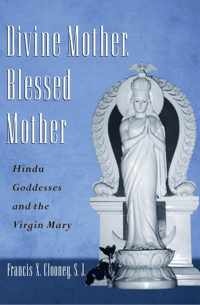
Francis Clooney warns that hymns yield little to a reader who approaches them for information alone. A hymn speaks to someone, and whoever takes it seriously comes near the relation it enacts, with some risk of being drawn in. His book is built accordingly: Hindu hymns of praise stand beside Marian ones, goddess and Mother of God read in pairs, and the reader is asked to cross over and return changed by what the unfamiliar text has made audible. Somewhere in the middle chapters I recognised, in a much smaller way, a desire these essays share: to let a text disturb the terms in which I had first approached it. Clooney does this deliberately, with a scholar’s patience, and accepts that the reader who crosses over cannot fully control what returns with him.
I followed him by listening in the evenings, with my rosary on the table beside me. Knowing too little to listen as a scholar, I could only enter by sound: a voice leaning into a phrase, a name returning, a small lift of rhythm, the silence after a line. The hymns seemed near and strange at once, until certain gestures became recognisable before I knew what they meant. They brought me less new doctrine than rememberings, returning things I had once known how to want.
The first was the Śrī Guṇaratna Kośa, Parāśara Bhaṭṭar’s Sanskrit praise of Śrī at Srirangam, sung by a man with a playfulness I had not expected. Śrī teases and persuades; her mercy is clever rather than ponderous, and the divine couple appear not only in majesty but in pleasure, wit and abundance. Then I saw Ranganāyaki at Srirangam, seated beneath flowers, textiles and jewellery until the figure seemed almost made of offerings. It startled me as an image of what hyperdulia might look like if I allowed it more matter, ornament and delight.
The theological difference is absolute: Śrī is divine, while Mary is a creature. Yet the image exposed how narrow my own expectations had grown. I have known Mary as refuge, obedience and sorrow, all of them true forms, but in my formation they had thickened into a complete weather system in which holiness is always grave and even splendour arrives dressed for a funeral.
This narrowness is not Marian praise as such. Clooney shows the point by setting Bhaṭṭar beside the Akathistos, whose greetings to Mary gather an extravagance that shades into wit: the unwedded bride, the container of the uncontainable, the space of the spaceless God. The praise piles up past every need, delighting in its own excess. The unfamiliar hymn did not supply what my tradition lacked; it sent me home to a room of my own house I had stopped entering.
This should have been less surprising. The Father of her Son is the source of excess: creation is unnecessary abundance, and at Cana there is more wine than the wedding can drink. I cannot turn this into a doctrine of Marian delight, but the intuition now has weight for me, since it would be strange if the Mother nearest this prodigality were untouched by it. I noticed what the thought did in my chest. I have longed for care and distrusted many of the forms in which it arrived. Play had felt frivolous to me for years; being forgiven I could believe, but being enjoyed felt almost indecent. Śrī’s hymn, and behind it the Akathist, remembered another possibility: care may delight that someone exists.
The Saundarya Laharī began differently. Its opening claim is startling: Śiva can act only when united with Śakti, so the feminine is honoured as power itself, the moving principle without which nothing moves. Clooney’s comparison makes the boundary more important, not less, because Devī is not Mary and God needs no complementary principle.
The hymn did not make Mary seem more like Devī; it made passivity seem less like Mary. Aquinas says that the Virgin’s consent is sought on behalf of humanity, but in Mary that formula becomes bodily. Daughter Zion answers in one woman’s voice, and the Word takes flesh from her. Her fiat is not assent added to a divine act already complete elsewhere; it belongs to the human form the Incarnation assumes.
What returned to me was not the exhausted fantasy of a woman required to animate everyone around her. It was something quieter: that one may receive without disappearing, consent without becoming merely compliant, and help give form to a life one has not originated. Mary is not the source of the Word, but she is not incidental to the way the Word becomes flesh.
With the Sulamangalam Sisters singing the Apirāmi Antāti, the atmosphere softened. The two women carried the hymn with a tenderness steadier than play, and I wondered whether delight had turned into labour. The form answered me. In an antāti, the last word of each verse becomes the first word of the next, so that one ending is already another beginning. The praise circles, resumes and finds another way to address her. The work belongs to the singers, but the form let me hear Apirāmi as the one still there when the next verse began. Play had accepted repetition and become dependable.
Clooney’s pairing reached furthest into my own practice here, because the Marian hymn beside Apirāmi’s is itself an antāti, the Mātāracammaṉ Antāti, Tamil Catholic praise of Mary in the same linked-verse form. The circling return I thought I was borrowing already existed within Marian devotion, in a language and poetics I had never met. Once seen there, it appeared everywhere at home: the Angelus returns at appointed hours, while the rosary circles through the same prayers and mysteries bead by bead. On difficult days the repetition can feel exacting; on better days it is a relief that nothing need be invented. The beads stay where they were left, and the prayer can be neglected and resumed.
For a long time I believed every interruption destroyed the bond, and that return required apology, proof or the recovery of an emotional state gone cold. Hearing the sisters hand each verse its next beginning, I recognised that the rosary had been contradicting this in me for years. The work of attention belongs to the one who prays, yet I came to see the relationship as held from the other side: care may survive one’s departure, and the next bead remains there when one returns.
Clooney pairs the Saundarya Laharī with the Stabat Mater. I heard the latter through Vivaldi and let it come last because it carried a different weight, without Śrī’s play, Devī’s movement or the antāti’s circling tenderness. Mary stands beneath what cannot be prevented or repaired, while Vivaldi refuses to let the sorrow hurry; the phrases lower themselves into the same place and remain there. This stillness is itself a severe work, since to stay beside suffering without converting it into explanation or consolation is among the hardest forms of presence I know, in the consulting room as much as at the foot of the Cross. Care may be unable to lift the weight, yet it can refuse to leave the person beneath it alone.
Clooney offers no composite Mother, and neither do these hearings. Śrī, Devī, Apirāmi and Mary remain themselves; across their differences, I heard four wishes I recognised in myself: to be delighted in, helped into life, permitted to return, and not abandoned beneath an unlifted weight. They are not definitions of what a mother ought to be, nor demands that any human mother could bear. They are forms of care the hymns helped me name.
The book has gone back to the shelf. The rosary is on the table where it was before I started, and the next bead is exactly where I left it. I will begin again there.